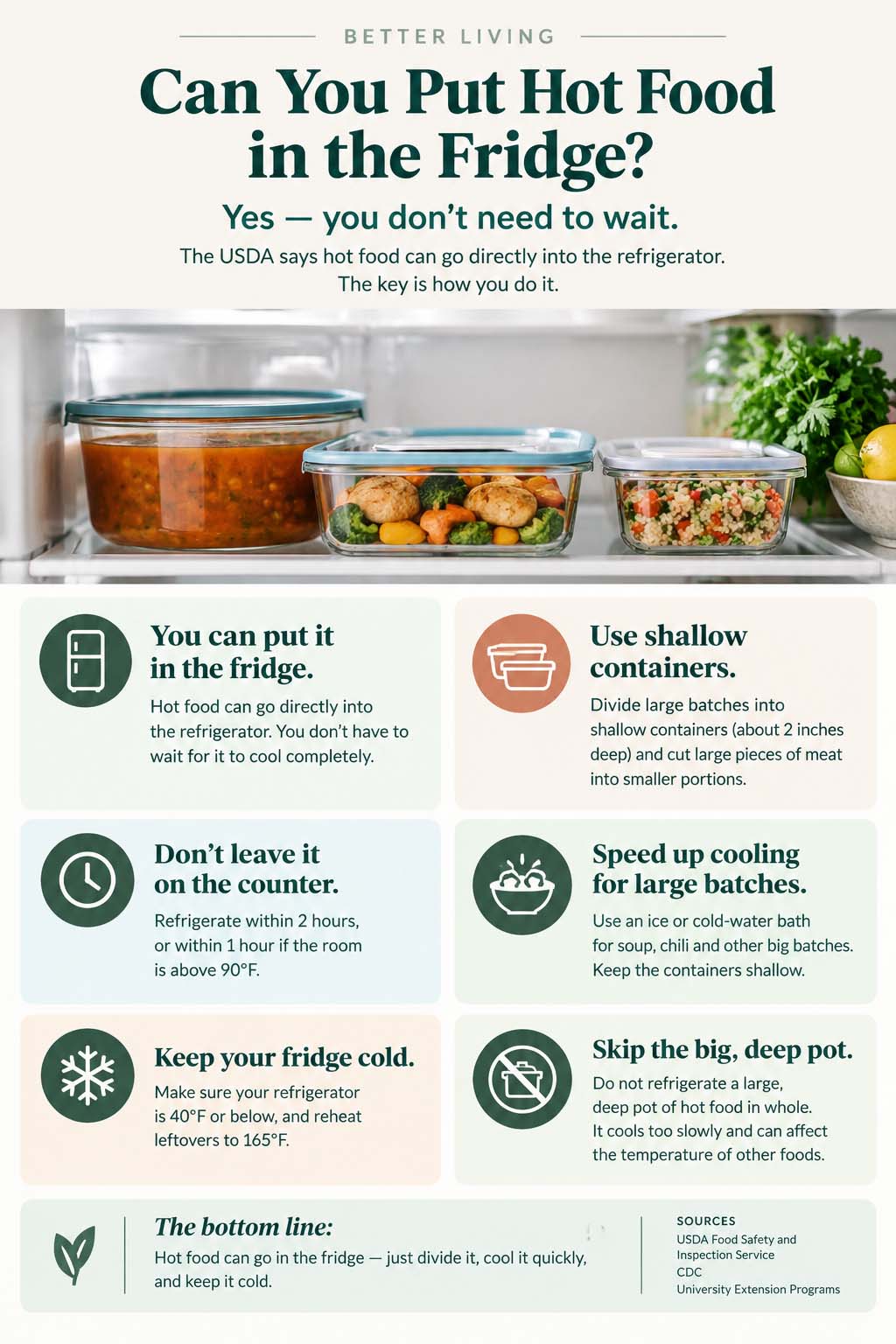
Can you put hot food in the fridge? Yes. The USDA Food Safety and Inspection Service says hot food can be placed directly in the refrigerator, so you do not need to wait for it to cool down before it goes in. The catch is how you do it. A big, deep pot of hot soup cools slowly in the middle, and one university Extension program warns against putting it in whole. Below is what federal agencies and Extension programs actually say, where they differ, and a simple method that works for everything from chili to a roast.
The short answer: yes. Hot food can go directly into the refrigerator if you divide it into shallow containers first. The one thing to avoid is putting a large, deep pot of hot food in whole.
Key takeaways
- You do not need to wait for food to cool completely before refrigerating it, according to the USDA and several Extension programs.
- Container size matters most: divide large batches into shallow containers, about 2 inches deep, and cut roasts into smaller pieces.
- Time matters too: refrigerate within 2 hours, or within 1 hour if the room is above 90°F.
- Use an ice or cold-water bath to speed up large batches such as soup or chili.
- For freezing, Extension guidance is to cool food in the fridge first.
Hot food in the fridge at a glance
| Question | Quick answer |
|---|---|
| Can hot food go in the fridge? | Yes, in shallow containers |
| Container depth | 2 inches or less (N.C. Extension allows up to 3) |
| Time limit | Within 2 hours, or 1 hour above 90°F |
| Large batches | Divide them, and use an ice or cold-water bath |
| Big, deep pot | Do not refrigerate it whole |
| Freezer | Cool in the fridge first |
| Fridge temperature | 40°F or below |
| Reheat to | 165°F |
| Leftovers keep | 3 to 4 days in the fridge |
What the experts say about putting hot food in the fridge
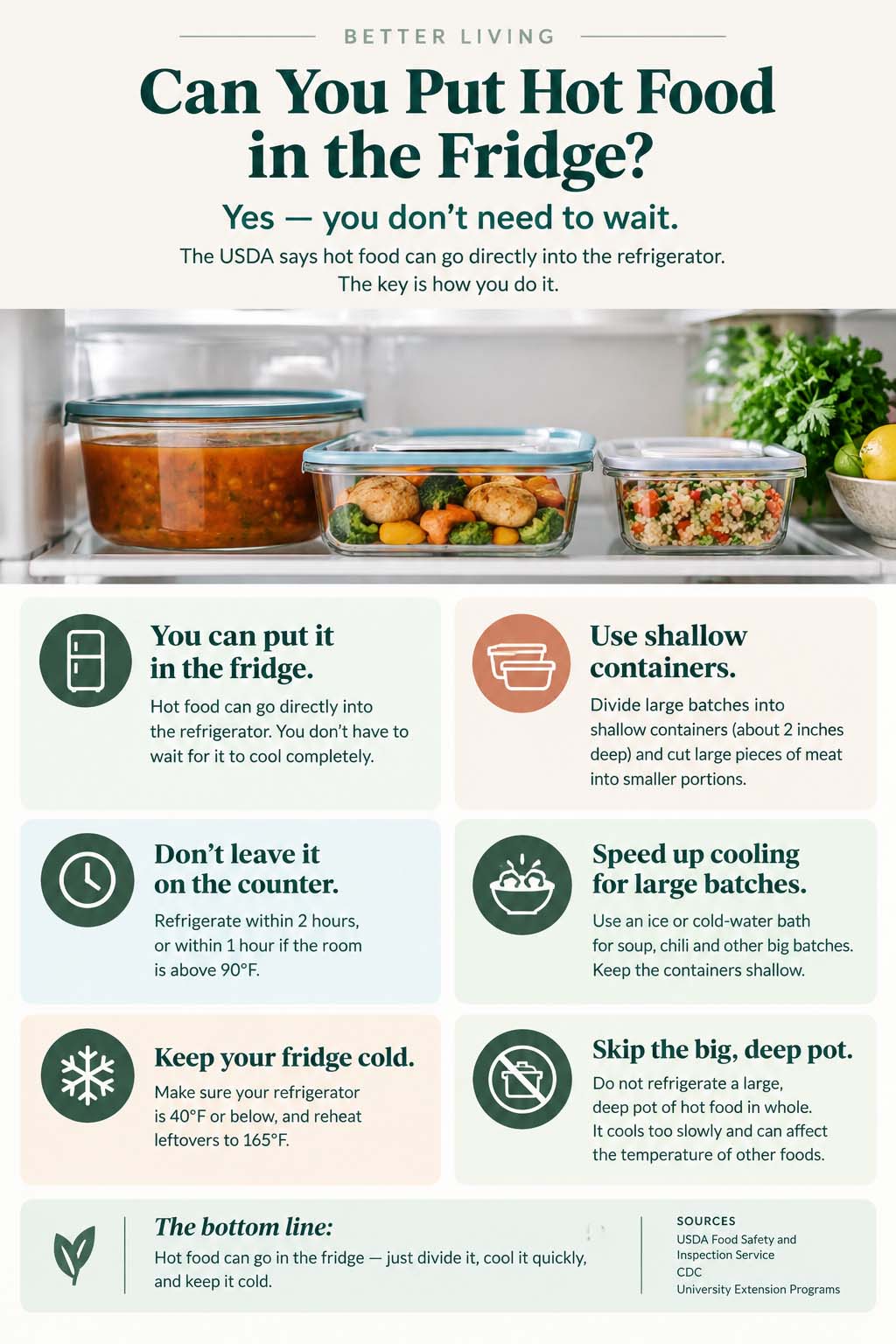
The sources are not word for word the same, so here they are side by side.
| Source | What it says |
|---|---|
| USDA (page updated 2020) | Hot food can be placed directly in the refrigerator, or rapidly chilled in an ice or cold-water bath first. Divide large amounts into shallow containers, and cut whole roasts or hams into smaller parts. |
| Center for Science in the Public Interest (2025) | Quotes NC State food safety expert Ben Chapman, who says people should put hot food in the fridge. Use wide, shallow containers no more than 2 inches deep, and leave food uncovered or partly covered while it cools. |
| Michigan State University Extension (2022) | Place hot food in the refrigerator, or chill it quickly in an ice or cold-water bath. Divide large amounts into small, shallow containers. |
| N.C. Cooperative Extension (2022, updated 2025) | Food depth should be 3 inches or less. For large amounts, use an ice bath first. Cover loosely until the food is cold, because lids slow cooling. |
| Mississippi State University Extension | Food does not need to be completely cool before it is refrigerated. Limit its depth to 2 inches and cover it loosely. |
| K-State Research and Extension (2024) | Never place a large container of hot food, such as soup, in the refrigerator because it cools very slowly. Use small containers about 2 inches deep, and put them in an ice water bath to speed cooling. |
Our reading: these do not truly contradict each other. None of them says food must cool completely to room temperature before refrigeration. The difference is container size. The go-ahead applies to food divided into shallow containers, and the warning applies to one large, deep container. Our takeaway is that hot food can go in the fridge, just not in a big deep pot. The sources also differ slightly on depth (2 inches, or up to 3 per N.C. Extension) and on lids, covered in the steps below.
Mississippi State allows a brief rest: it suggests letting a shallow container sit on a cooling rack for about 20 to 30 minutes before refrigerating, but waiting is not necessary. That rest counts toward the 2-hour limit below, which the page describes as a total for the food at room temperature.
Why you should not leave hot food on the counter
The real risk is time. The CDC says to refrigerate food at 40°F or colder within 2 hours of cooking, or within 1 hour if the food is in temperatures hotter than 90°F. It also says foods cooked in large batches and held at unsafe temperatures have been linked to outbreaks of C. perfringens food poisoning. The USDA gives the same limits, and says perishable leftovers left out longer should be thrown away.
These limits exist because of what the USDA calls the “Danger Zone,” the 40 to 140°F range in which, according to a USDA release, bacteria can grow faster and can double in number in as little as 20 minutes when perishable food is kept in it. Hot food is out of that range only at the start and the end of cooling, so the goal is to get through the middle quickly.
Food establishments follow a more specific, temperature-based cooling schedule. The traditional FDA Food Code benchmark, as described in a 2017 Texas Department of State Health Services fact sheet, is that cooked food must cool from 135°F to 70°F within 2 hours and then to 41°F or colder within 4 more hours, with a total cooling time that never exceeds 6 hours. Requirements can depend on the local code. This is written for food businesses, not home kitchens, and it does not mean food may sit on the counter for six hours or that home leftovers must reach 40°F within two hours. Refrigerate promptly and use methods that cool the food rapidly.
| Setting | Cooling limit | Source |
|---|---|---|
| Home leftovers | Refrigerate within 2 hours (1 hour above 90°F) | USDA and CDC |
| Food businesses (traditional FDA Food Code benchmark) | 135°F to 70°F in 2 hours, then to 41°F in 4 more hours | Texas DSHS (2017) |
How to cool hot food safely, step by step
- Divide it into shallow containers. K-State Research and Extension says to use small containers about two inches deep, Mississippi State University Extension says to limit depth to 2 inches, and the Center for Science in the Public Interest says no more than 2 inches. N.C. Cooperative Extension allows up to 3 inches. We suggest aiming for 2 inches or less. The USDA also says to cut large items, such as a whole ham or roast, into smaller portions.
- Speed it up with an ice or cold-water bath. The USDA and Michigan State University Extension both list this as an option. K-State suggests setting smaller containers in an ice water bath. Our practical tip: stir the food now and then, and keep the water level below the container rim so none gets in.
- Give containers room. The Texas DSHS fact sheet for food establishments lists leaving food uncovered and not stacking containers until properly cooled as a rapid-cooling method. Our practical tip: leave gaps between containers so air can move around them until the food has chilled.
- Cover loosely at first. The sources differ a little on lids. Chapman, quoted by CSPI, says to leave hot food uncovered or partly covered while it cools. N.C. Extension and Mississippi State say to cover loosely, and N.C. Extension adds that lids slow cooling. The USDA and Michigan State University Extension say to cover leftovers or seal them airtight, which applies to storage. Our practical way to reconcile them: use a loose cover while the food is cooling, then cover tightly once it is cold. Do not leave food on the counter waiting for it to cool completely.
- Check the fridge. The FDA says to keep the refrigerator at 40°F or below, using an appliance thermometer.
- Label it and use it soon. The USDA says refrigerated leftovers keep 3 to 4 days. Put a date on the container.
Special cases
Soup, chili and stew
These are the foods the warnings are about. Texas A&M Dinner Tonight, citing USDA guidance, uses a big pot of soup as its example of food that takes a long time to cool, and K-State says not to put a large container of hot soup in the fridge. Chapman gave CSPI the example of a very deep pot of chili whose middle could still be 50 or 60°F days later. Ladle it into several shallow containers, or set small containers in an ice bath, before refrigerating. When you reheat, Michigan State University Extension says to bring soups, sauces and gravies to a rolling boil. See our soup mistakes guide.
Roasts, turkey and ham
The USDA says to cut large items into smaller portions to cool. Our practical note: carve a roast or turkey off the bone and divide it among containers instead of refrigerating it whole, since a big piece holds its heat. More in our guide to how long ham keeps in the fridge.
Rice
The N.C. Cooperative Extension says cooked rice can carry Bacillus cereus spores, that the toxin this bacterium can produce is heat resistant, and that it can cause vomiting or diarrhea. At home, treat rice like any other leftover: cool it promptly in shallow containers, refrigerate it within 2 hours (1 hour above 90°F), and do not leave it out overnight. The same page advises reheating only the portion you plan to eat. For how long it keeps, use the USDA window of 3 to 4 days.
Rice kept hot in a cooker is a different case. CSPI quotes Chapman saying that rice held above 135°F on a cooker’s warm setting is too hot for B. cereus to grow. Our note: that applies only if the cooker really keeps it that hot, not if it is switched off or lukewarm. See does rice need to be refrigerated and does rice go bad.
Freezing
For freezing, follow the sequence Extension programs recommend: cool the food rapidly in shallow containers in the refrigerator, then move it to the freezer. Mississippi State University Extension says not to put hot food into the freezer and to let it get to refrigerator temperature first, and K-State suggests small, freezer-safe containers. Our list of foods you should never freeze covers what does not freeze well.
Reheating and how long leftovers last
The USDA, Michigan State University Extension, K-State and the CDC all say to reheat leftovers to 165°F, measured with a food thermometer. Refrigerated leftovers keep 3 to 4 days according to the USDA, and frozen leftovers keep 3 to 4 months for best quality, not as a safety deadline. See why it is bad to reheat food twice and our leftovers guide.
What if hot food sat out too long?
Throw it out. The USDA says perishable food left out for more than 2 hours (1 hour above 90°F) should be discarded. Reheating is not a reliable fix, because according to NC State the toxin Bacillus cereus can produce is heat resistant.
Hot food in the fridge: your questions, answered
Can you put hot food in the fridge?
Yes. The USDA says hot food can be placed directly in the refrigerator. Divide large amounts into shallow containers so it cools faster.
Must food cool down before it goes in the fridge?
No. Mississippi State Extension says food does not need to be completely cool first. It suggests an optional 20 to 30 minute rest on a cooling rack for a shallow container, with the food refrigerated well within 2 hours.
Does hot food raise the temperature of the fridge?
It can. The Texas DSHS fact sheet warns that a warm or hot item may warm the inside of the unit and jeopardize the safety of other stored foods, while Chapman says modern refrigerators can handle hot food. That is not a reason to leave leftovers on the counter. Divide food into small, shallow containers, use an ice bath for large batches, leave room for air circulation and keep the refrigerator at 40°F or below.
See also

Why do people think you should not put hot food in the fridge?
Chapman told CSPI that pre-1970s refrigerators had to work harder with hot food and that modern ones can handle it. That is his explanation, not a documented history.
What is the danger zone for food?
The USDA defines it as 40 to 140°F, the range where bacteria can grow faster and can double in as little as 20 minutes.
Can you put a whole pot of hot soup in the fridge?
K-State says never to put a large container of hot food, such as soup, in the refrigerator because it cools very slowly. Divide it into shallow containers first.
How long can cooked food sit out?
No more than 2 hours, or 1 hour when the temperature is above 90°F, per the USDA and CDC.
Should you cover hot food in the fridge?
Mississippi State and N.C. Extension say to cover it loosely, and Chapman says to leave it uncovered or partly covered while it cools. Michigan State says to seal leftovers in airtight packaging or containers for storage. We suggest a loose cover while it cools and a tight seal once it is cold.
Can you put hot food in the freezer?
Mississippi State Extension says not to put hot food in the freezer and to let it reach refrigerator temperature first. K-State suggests small, freezer-safe containers.
How long do leftovers last in the fridge?
3 to 4 days, according to the USDA, Michigan State and K-State.
Is it safe to leave cooked rice out overnight?
No. Rice left out overnight is well past the 2-hour limit (1 hour above 90°F), and the USDA says perishable food left out longer should be thrown away. NC State adds that the toxin that can form is heat resistant, so reheating may not make it safe.
The bottom line
Hot food can go directly into the refrigerator. Divide large batches into small, shallow containers, cut large pieces of meat into smaller portions, and refrigerate promptly, within 2 hours or 1 hour above 90°F. For large batches, an ice bath can help food cool rapidly. Do not refrigerate a large, deep pot intact.

Better Living may earn commissions through affiliate links and may occasionally feature sponsored or partner content. If you make a purchase through our links, we may receive a small commission at no cost to you.